Showing posts with label Supawich Somboonsub. Show all posts

Sunday, 6 December 2015

Algae-Based Waste Water Treatment Museum and Research Centre


My project is wastewater treatment plant in Cadiz that uses wastewater in beneficial way to produce products and also turn it into an architectural didactic place to make people raise their concern about the water condition

.

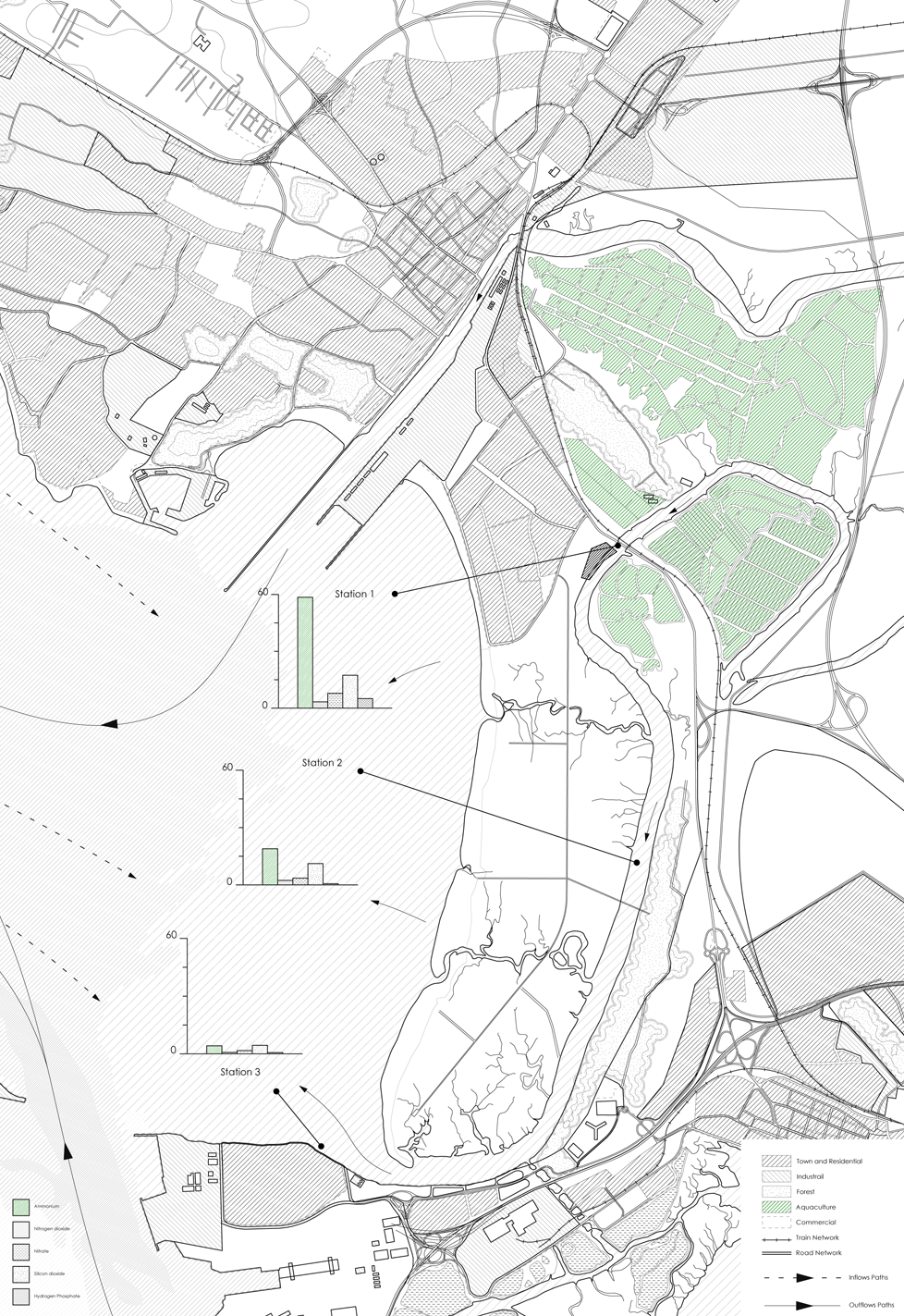
Cadiz is the city located by the coast in southwest of Spain which has a long history of polyculture as well as aquaculture. Since 1940, large piece of land along San Pedro River that was once used to be salt pan now has turned into fish farm. As the result of this, the level of ammonia in the water is high due to the high density of fish farm. As the number of fish farms grows, the wastewater discharged to the water is also increase


Ammonia, which is the product of the decay of these wastes, has been discharging into the channel down the stream which the natural park is located causing the interruption in the preserved land’s ecosystem. To protect the natural park, the level of ammonia must be lowered before it could enter the preserved zone.


To reduce the ammonia in the water, algae-based waste water treatment is introduced because the fact that for algae to grow, it needs carbon dioxide, sunlight, and most importantly, ammonia as its source of nutrient. Therefore, in the end of this water treatment process, algae are also the product of it which could be extracted and turned into biofuel. The water from the river is guided into the system through the grit bar to screen out the large objects, and then to the sedimentation ponds to remove sludge. After that, the water will be transferred into the algae cultivation process to remove the excess nutrients in the water. Algae will be harvested and to the algae extraction lab while the filtered water will be discharged into the river with lower level of ammonia. Also, the system will be used as the indication of water condition and I envision it as a research center of the water treatment and the public space for visitors to learn and appreciate the process of the system.


The site will be located where San Pedro River and Valdelagrana Road intersects which is where the end of fish farming and the start of the natural park meets to prevent the excess of ammonia in the water before it entering the natural park. The plant is placed by the left side of the river to connect with the two existing access path which are the road connected to the main street where the parking is available, and the dirt trail accessible through the natural park by either bicycle or walking.


The buildings are divided into mainly three levels, lower level, ground level, and roof area. Lower level is the area where wastewater treatment plants, the research lab and the office are placed. Ground level consists of the main reception which is connected to main accessible routes and the pedestrian path where visitors could experience and appreciate the space. The roof area is the green roof connected to the ground using slope to create the seamless transition between the roof and the wetland landscape. 


There are two main circulation paths, one for visitor and other for workers. Visitors will enter through the reception hall, and then proceed to the main path which they will first encounter the grit bar filter and the sludge tank. And then, they will circulate around the sediment ponds where they could experience the 360° view of the site and landscape. The next facilities they will run into are the algae raceway ponds and algae extraction and research lab. They will then proceed to the outlet of treated water at the end of the plants. At the end of the path, visitors could choose to have some rest the restaurant or follow the path that makes a loop to the roof garden and back to the reception. Service path for workers in the other hand is the slope down to the lower level through the sides of the site. It leads to each treatment plants, the lab and the storage area where only workers are permitted.


The tide will slow the mass of moving water fed into the system so that the residence time will allow algae to be cultured. With the interval of the tide twice a day, residence time will last for 4 hours allowing the water to settle with the right condition to culture algae. The tide will also reveal part of the land in the site when it is low creating the extra public space and gathering point for people.


In the end, this wastewater treatment will lower the level of ammonia and the ammonia entering the natural park by using algae to consume nutrients and it will be a research and study ground that gives the information and raise the awareness of the water condition to the visitors.


Tuesday, 20 October 2015

Parque Natural Bahía de Cádiz

In Cadiz, in the preservation area, the natural park is standing side by side with ports, cities, residential areas, industrial zone, as well as salt pan and fish farming. As the statistic shows, the population is over the year surrounded the park. Even though the park is well preserved, city is still growing rapidly and soon will overwhelm the border of the park

In Cadiz, in the preservation area, the natural park is standing side by side with ports, cities, residential areas, industrial zone, as well as salt pan and fish farming. As the statistic shows, the population is over the year surrounded the park. Even though the park is well preserved, city is still growing rapidly and soon will overwhelm the border of the park


Over the years, it can be seen in the diagram that the city is expanding and the population in the cities around the border of the park is rising up steadily. When was then used to be a small town, has now become the bigger city. Pine forest in some area also has changed into the university campus.


There is variety of ecosystem along the channel and also various marine species which can be found in the area such as, shrimp, craps, sea shell, etc. There are three main species of fish along the channel which are sole, grey mullet, and sea bass. Sole can be spotted by the river delta while sea bass prefers open sea. Grey mullet is founded along the stretch of the channel. Some species such as sole is suffering from the decrease in population due to the over fishing.

In the park itself, it is restricted area but it also welcome tourist to do the activities that is harmless to the nature such as hiking, cycling, bird watching, as well as rod fishing. By the south of the park, Puerto Real, there are industrial area, residential area and university campus that is growing over time. On the right side of the channel, it is mostly used for salt extraction and fish farming. On the top of the park, Santa Maria, there is a residential area as well as series of tourism program.


The extreme condition founded in the site is caused by tides. It fluctuates by approximately 2.5 metres. When the tide reaches the maximum, marsh land could be flooded by 10-30 metres from the rive bank towards the land. 

The proposal I would like to make is  a buffer zone between the city and nature area as a natural museum in the area to raise the awareness of the danger that the park might face and to give the knowledge about the nature and ecosystem in natural park. Placing by the university campus, it could as well be the research center for them as well as the place to display their works. And hopefully, the buffer zone could blend the transition between city and nature and stop city to invade more into the nature. It would perhaps, stop the tendency of the town to grow towards the natural park.

Sunday, 13 September 2015

Re-terrain Surface Unit

From the previous research prototype model, multiple rings surrounded the square platform was used to recreate the new terrain surface enclosing the area. However, due to the large contact ground on the individual ring, there is the limitation when it comes to resting in the unstable and uneven ground. Therefore, the structure is divided into units connected into one structure.


The hexagonal unit is tethered together loosely by using the vertical rails which makes the whole system intact. Each unit acts as an individual buoy possessing different buoyancy making it float with a different draft. This system will eventually be able to recreate the terrain. It could perform the mirror of the ground as it shows above, or it could even perform other countless variation of a terrain. It could also be attached into the larger land depending on the number of unit connected. This system will be able to sit on the uneven terrain, wrapping the ground creating the habitation surface.

As the water level is rising, the system will gradually float up creating the new program of the space. What is used to be the high ground will now become a void allowing water to flood in the middle to create the enclosed water surface surrounded by the multiple units. When the water level reaches the maximum, the invert terrain will be created. With some weight added to each unit, each one will have the different variation of draft producing the contour. The system is anchored to the ground preventing it from drifting. Some of the unit is, however, can be fixed to the ground acting as an anchor itself


Thursday, 3 September 2015

Technical Analysis of A Gyroscopic Stabilizer

In the unstable ground condition, it might cause the habitat surface to be unlevelled causing the unpleasant condition. Therefore, I would like to do the research on how could be stabilize the surface in harsh environment. Gyroscopic stabilizer is one of the answers on how to keep the plane leveled.

For example, Gyro Pool Table, it has gyro sensors installed on the deck of the ship sending the signal if the ship is tilting. The actuator arms will adjusts the playing surface to make it stay leveled; therefore, it is able to pool in the rocking cruise ship. Another example is boat stabilizer. It is the device that is installed in the boat or yacht. The rotated rotor will increase the angular momentum of the spinning mass (rotor) and that spinning mass will counteract a roll motion of the boat created by a wave making it more stable.

These two systems may eventually be a benefit to my further development on how to make a stable surface in unstable condition.